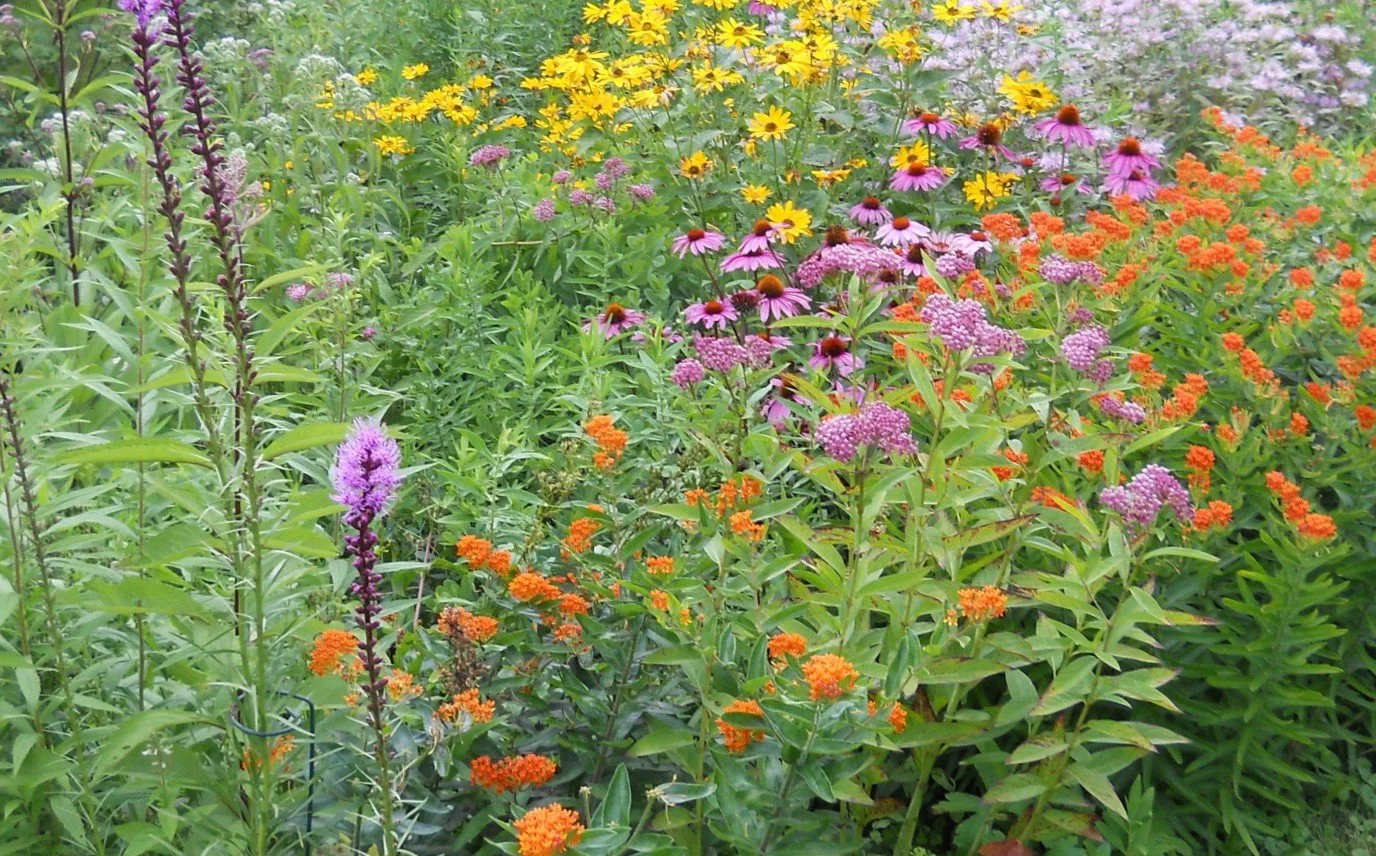
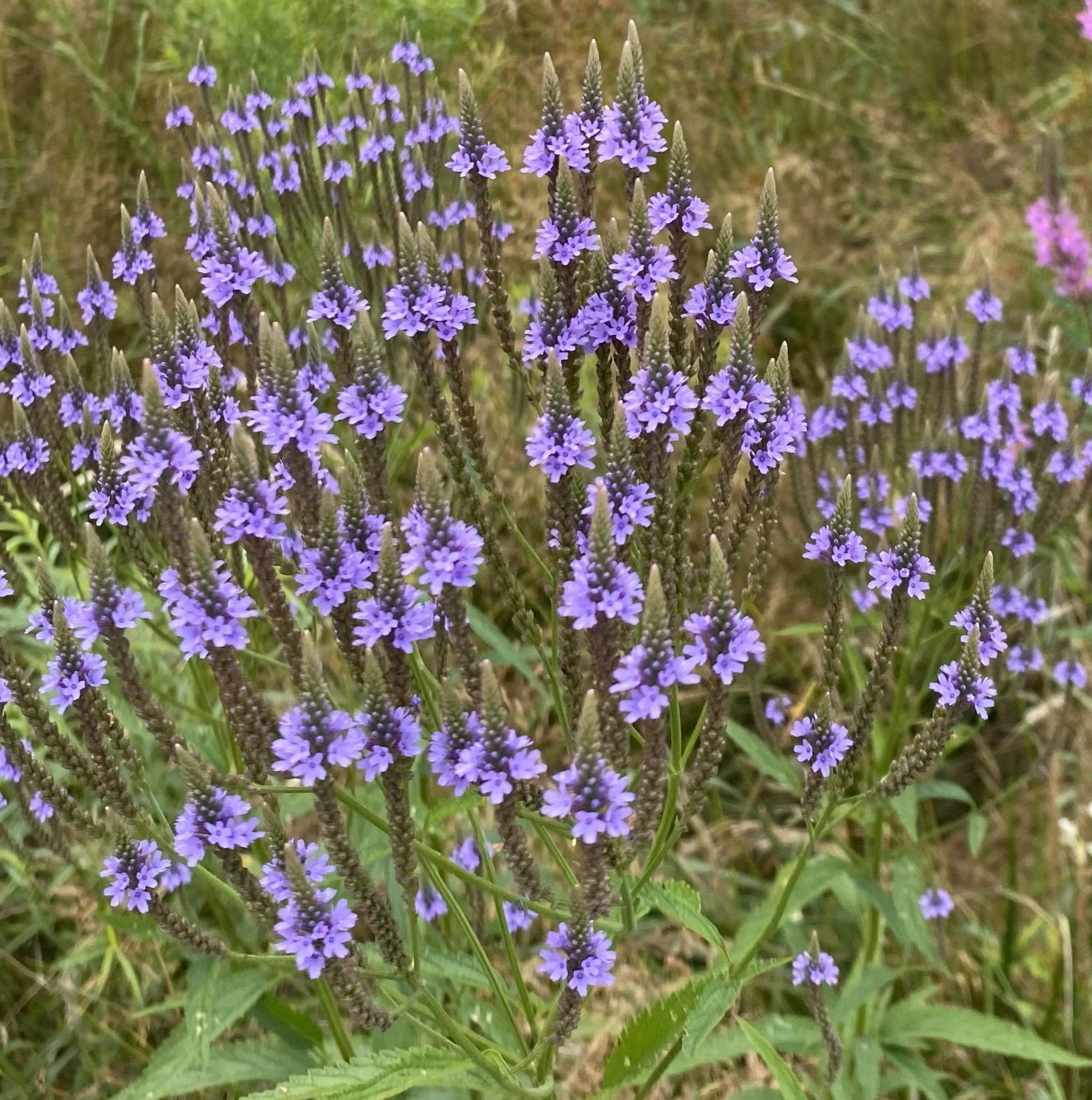
This native perennial is easily recognized by its unique branching flower spikes that resemble a multi-armed candelabra. Tiny, vibrant violet-blue flowers bloom in succession from the bottom up in the July heat. Unlike many garden perennials that shy away from "wet feet," Verbena hastata thrives in moist-to-wet soils, making it an invaluable choice for rain gardens, pond edges, or that low-lying corner of the yard where other plants struggle.
Sun Exposure Full Sun to Partial Shade
Water Needs Moderate to High; standing water is not tolerated, but it prefers consistently moist soil.
Soil Type Moist to wet; Can tolerate Muck, Clay, Loam or Sand.
Mature Height 4 - 6 feet
Deer Resistance Moderate to High
Bloom Time July – September
Bloom Color Blue
Plant Spacing 18 – 24 inches
Vertical Interest: Its tall, slender habit adds height without adding bulk, allowing it to weave beautifully between other plants.
Naturalizes Easily: A biennial plant that is a wonderful self-seeder. It also will slowly spread through rhizomes allowing it to fill in gaps over time, but it will not compete well with more aggressive vegetation.
Color: The violet-blue flower spikes can bloom for up to 2 months.
Butterfly Magnet: A vital nectar source for a wide array of butterflies, including Swallowtails, Fritillaries, and Skippers.
Native Bee Support: Blue vervain attracts a variety of different native bees.
Songbird Food: In the fall, the slender spikes produce tiny seeds that are a favorite for finches, and sparrows.
Pro Tip: Because Blue Vervain grows quite tall and narrow, plant it in clusters of three or more. This creates a stunning "haze" of purple-blue color that is much more impactful than a single specimen, and it provides extra support for the stems in windy areas.
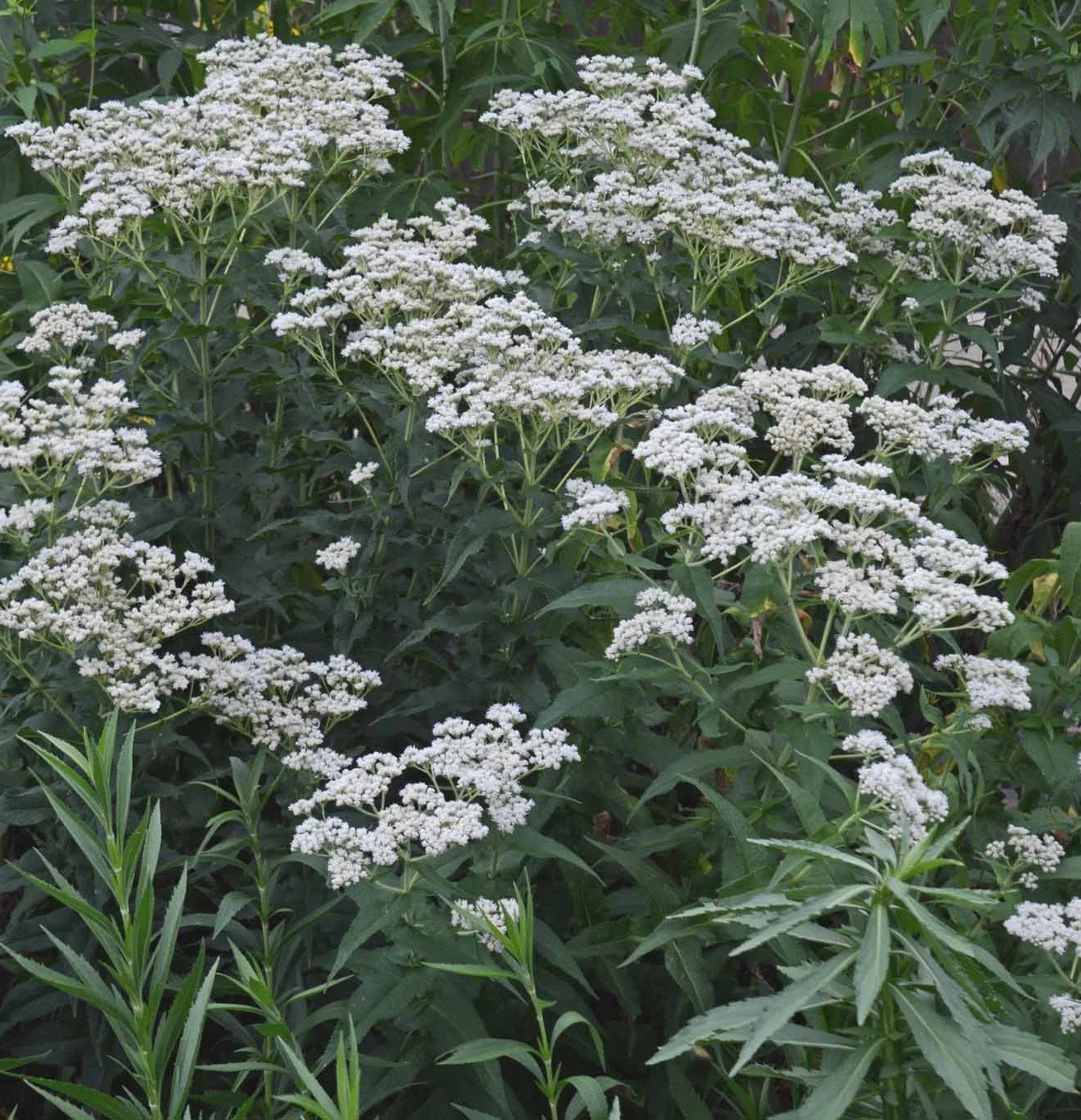
A true standout in the wetland or meadow garden. This hardy native perennial is instantly recognizable by its unique foliage. In late summer, the plant is topped with large, fuzzy clusters of fragrant, creamy-white blossoms. These flat-topped flower heads create a soft, cloud-like effect in the landscape, providing a nice contrast to the purples and golds of late-season asters and goldenrods.
Sun Exposure Full Sun to Partial Shade
Water Needs Moderate to High; prefers consistently moist to wet soil.
Soil Type Needed Thrives in moist Muck, Clay, or Loam; tolerates "wet feet."
Mature Height 3 – 5 feet
Deer Resistance High
Bloom Time July – September
Bloom Color White
Plant Spacing 1 – 2 feet
Unique Architecture: The "perfoliate" leaves provide a structural look that adds instant character to your garden beds. The pairs of textured, lance-shaped leaves are fused at the base, making it look as though the sturdy stem is growing right through the center of a single long leaf.
Wet Spot Solution: It is an excellent choice for rain gardens or areas with poor drainage where other perennials might struggle with root rot.
Late Summer Glow: While other plants are winding down, Boneset hits its peak, keeping your garden looking lush and full of life well into September.
Pollinator Super-Plant: Boneset is legendary for the sheer volume of insects it supports. It is a favorite of honeybees, native sweat bees, and beneficial wasps.
Nectar Source: A vital late-season fuel stop for migrating Monarchs and other varieties of butterflies and moths.
Late Season seed source: Goldfinches, chickadees, sparrows and juncos will feed on the fall seed heads.
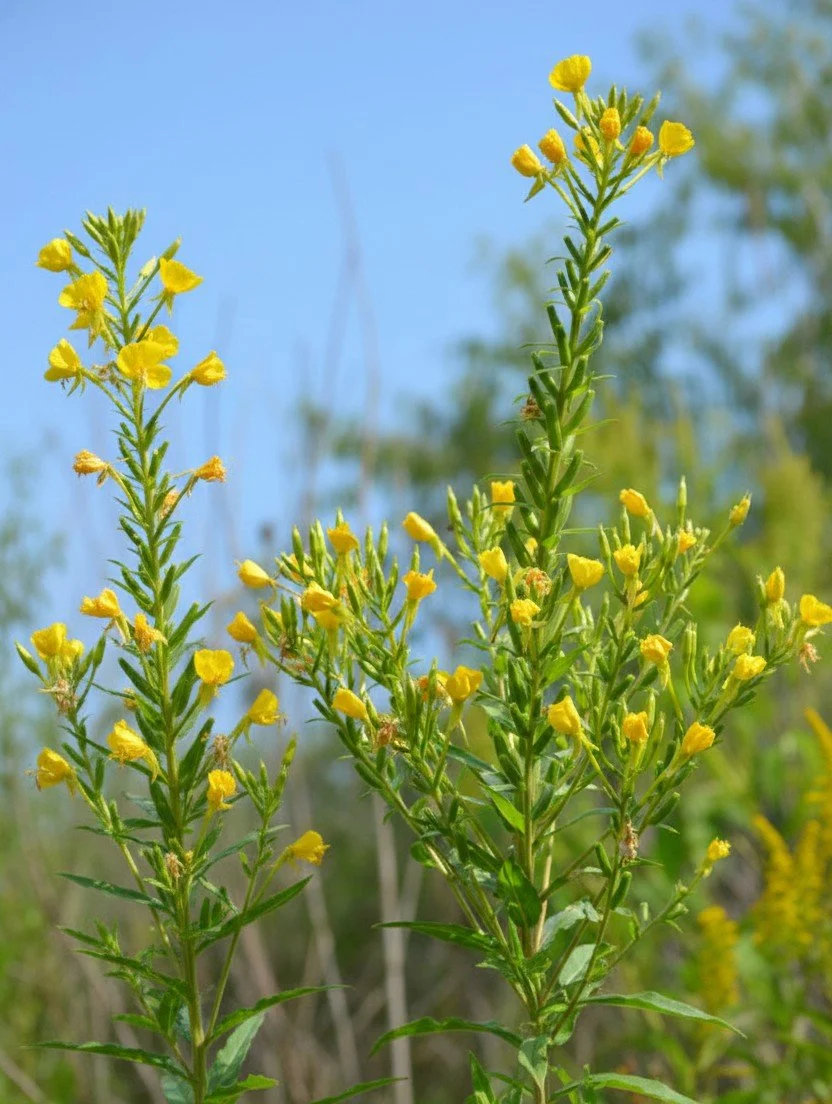
Just like the goldenrod, this plant is a "bridge" species—but while the goldenrod bridges the seasons, the Evening Primrose bridges day and night! While most flowers wake up with the sun, this native waits for the twilight. It features bowl-shaped yellow blossoms that unfurl in late afternoon and evening.
Sun Exposure Full Sun to Partial Shade
Water Needs Low to Medium; very drought-tolerant
Soil Type Adaptable; prefers Sandy, Rocky, or Lean soil
Mature Height 4 – 6 feet
Deer Resistance Low - Moderate
Bloom Time July – October
Bloom Color Yellow
Plant Spacing 1 – 2 feet
Long Bloom Time: It is one of the last natives blooming into late fall.
Hardy & Resilient: It thrives in "neglected" areas where other plants struggle. It is highly resistant to pests and can handle poor, dry soils with ease.
Polinators: Although labeled as a weed by some, it is a very important native plant with a long bloom time. It benefits many different kinds of bees, nectaring moths, butterfiles, and caterpillars.
The "Night Shift": The flowers attract sphinx moths (hawk moths), which are nocturnal.
Hummingbirds: Though they open late, the flowers stay open long enough for hummingbirds to visit them for a breakfast snack in the early morning.
Garden Note: Common Evening Primrose is a prolific self-seeder. Because it is a biennial, it relies on dropping seeds to ensure a new generation blooms every year. If you want to limit its spread, simply snip off the seed pods after the flowering season is finished!
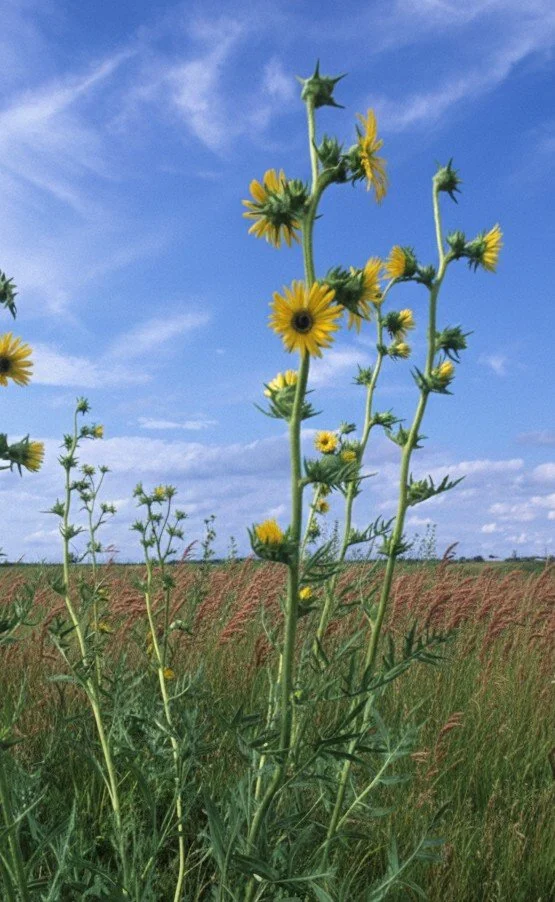
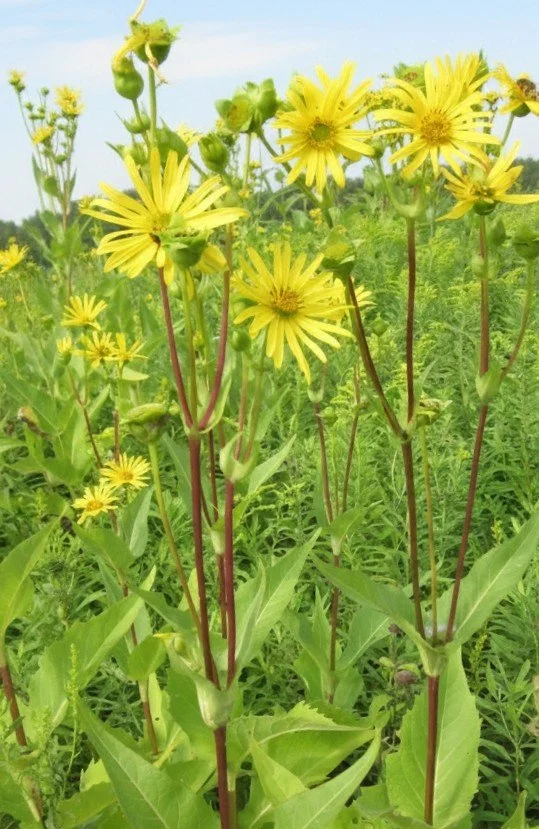
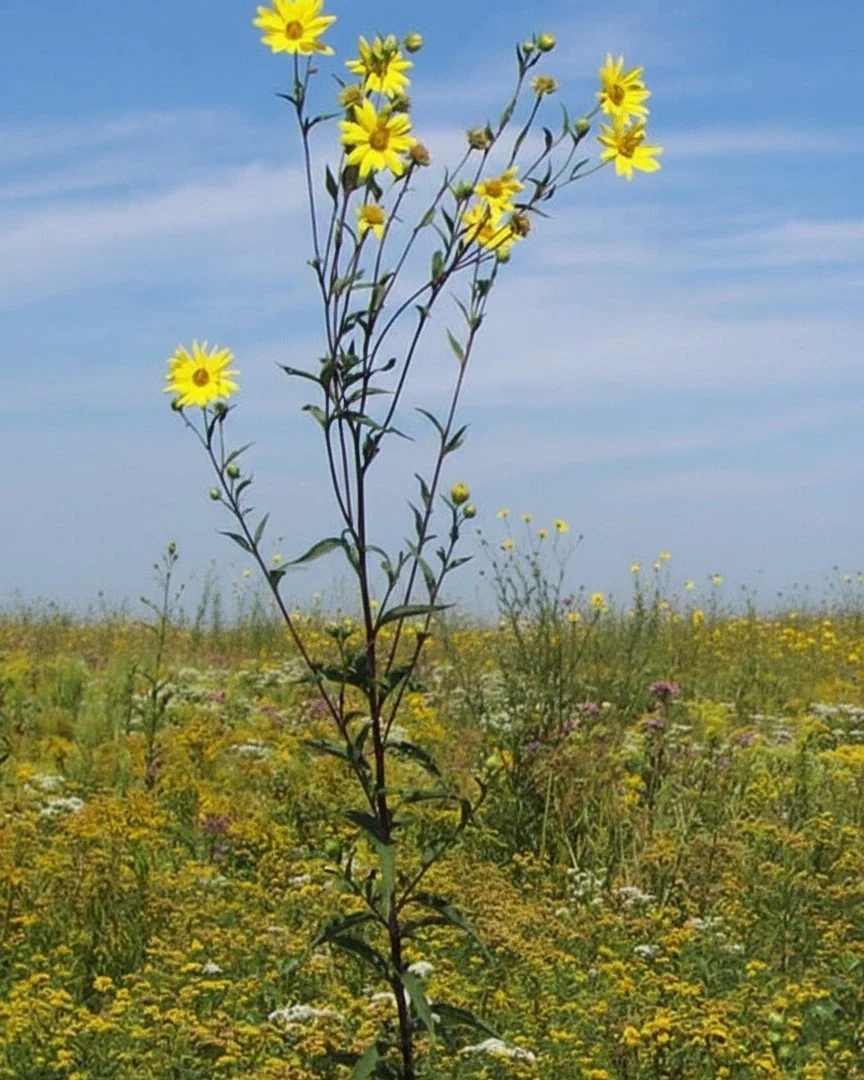
This towering native perennial is famous for its deeply lobed, sandpaper-like leaves that traditionally orient themselves North and South to avoid the intense midday sun—giving the plant its iconic name.Rising on sturdy, sap-filled stalks, its cheerful, sunflower-like yellow blooms provide a vertical element that can be seen from across the yard.
It is a slow-growing "anchor" species that invests its early years into developing a massive taproot that can reach up to 15 feet deep. This incredible root system makes it virtually bulletproof against drought and extreme heat, allowing it to remain lush and vibrant even when the rest of the garden is parched.
Sun Exposure Full Sun to Partial Shade
Water Needs Low to Medium; exceptionally drought-tolerant
Soil Type Loam, Sand
Mature Height 5 – 8 feet
Deer Resistance High
Bloom Time June – September
Bloom Color Yellow
Plant Spacing 3 – 5 feet
Height: Given rich soil, compass plants can reach upwards of 8 feet in height.
Living Compass: The large basal leaves align with the Earth’s magnetic poles to maximize water use in the leaves and increase CO2 gain.
Centuries-Long Life: This is a "legacy plant." Once established, a single Compass Plant can live for up to 100 years, becoming a permanent fixture of your home's ecosystem.
Pollinators: The resin-rich flowers are a favorite of bees, and butterflies.
Birds: Seeds are a high-energy food source for goldfinches and other songbirds throughout the fall and a favorite perching spot.
Pro Tip: Patience is a virtue with the Compass Plant! Because it spends its first few seasons focused on growing that legendary 15-foot taproot, it may only produce a small cluster of leaves at first. Don't be fooled—it is building the foundation for a lifetime of beauty. Due to this taproot, it is very difficult to move once planted, so choose its "forever home" in a sunny spot with plenty of vertical room to grow.
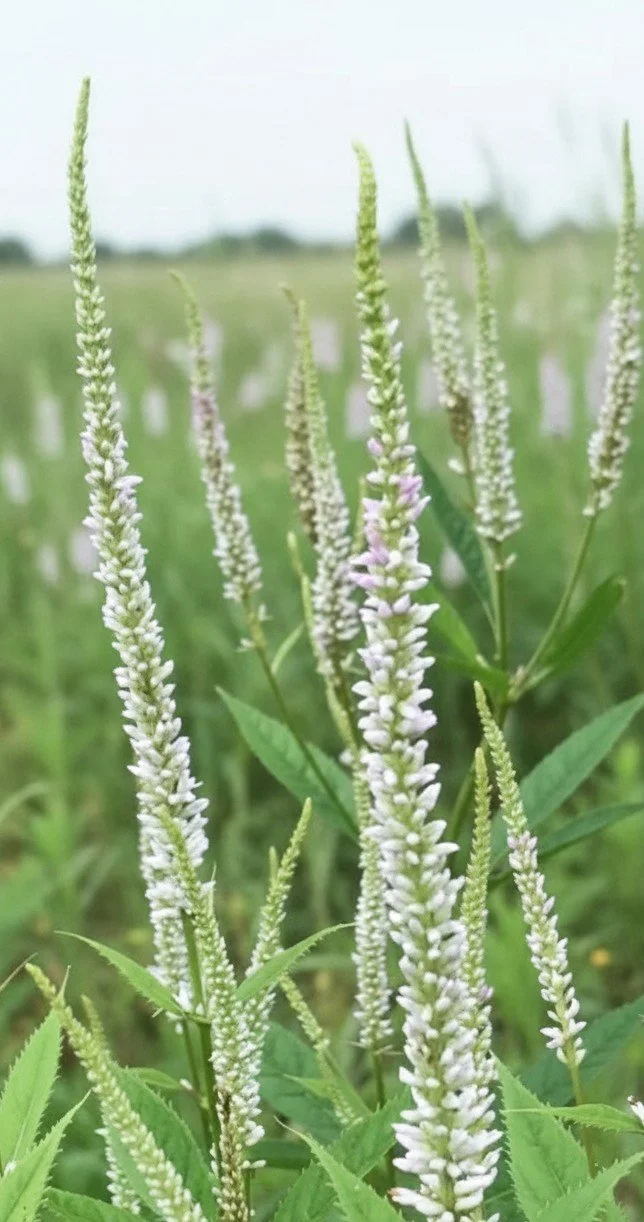
This stately native perennial is beloved for its unique, candelabra-like flower spikes that bloom in a soft white to pale lavender. Unlike the shaggy look of some prairie plants, Culver’s Root has deep green leaves arranged in tidy, horizontal "whirls" around the stem, providing beautiful texture even before the flowers appear. This plant is the perfect "bridge" for your garden, thriving in that sweet spot between moist and well-drained soils.
Sun Exposure Full Sun to Partial Shade
Water Needs Medium; likes moist, well drained soil
Soil Type Needed Muck, Loam, Clay, or Moist Sand
Mature Height 4 – 6 feet
Deer Resistance High
Bloom Time June – August
Bloom Color White
Plant Spacing 2 – 3 feet
Candelabra Blooms: Each main flower spike is surrounded by smaller secondary spikes, extending the bloom time and creating a multi-tiered "candelabra" effect.
Formal Structure: The unique "whorled" leaf pattern (growing in circles around the stem) gives the plant a clean, geometric look that fits beautifully in modern or formal landscapes.
Non-Aggressive: It is a well-behaved clump-former, meaning it stays exactly where you plant it and won't try to take over the rest of your garden.
Bees & Butterflies: It is a vital nectar source for butterflies and a variety of bees.
Pro Tip: Culver’s Root is a true "sun-seeker." While it can handle partial shade, its stems are sturdiest and its flower spikes are most upright when it receives at least 6 hours of direct sunlight. If you are planting it in a more shaded spot, consider placing it near a fence or sturdier neighbors like Joe Pye Weed for a little extra support. To encourage the best display, keep the soil mulch-covered to retain the moisture this "cool-season" beauty loves!
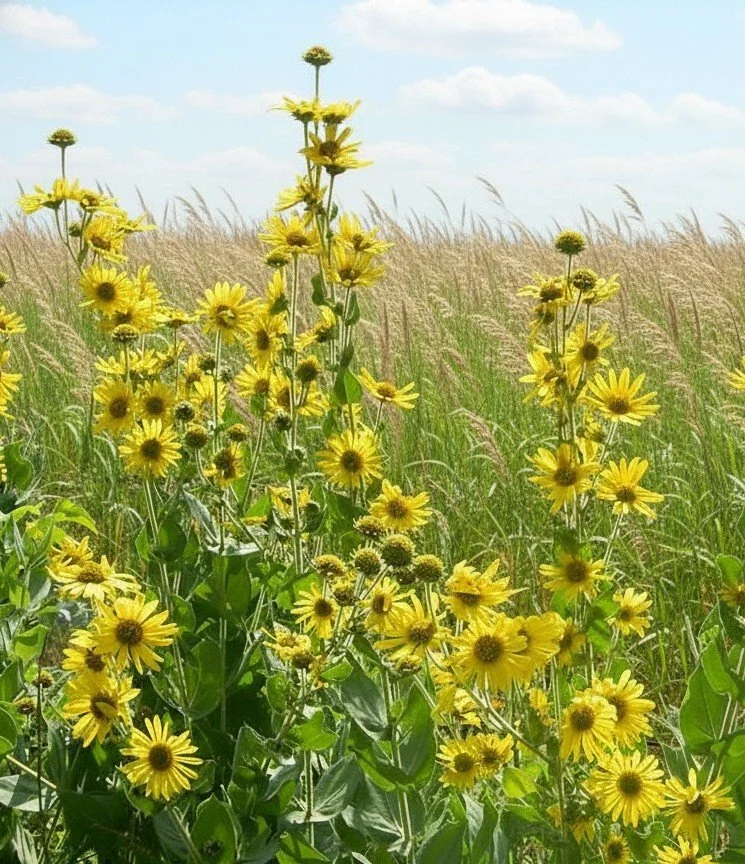
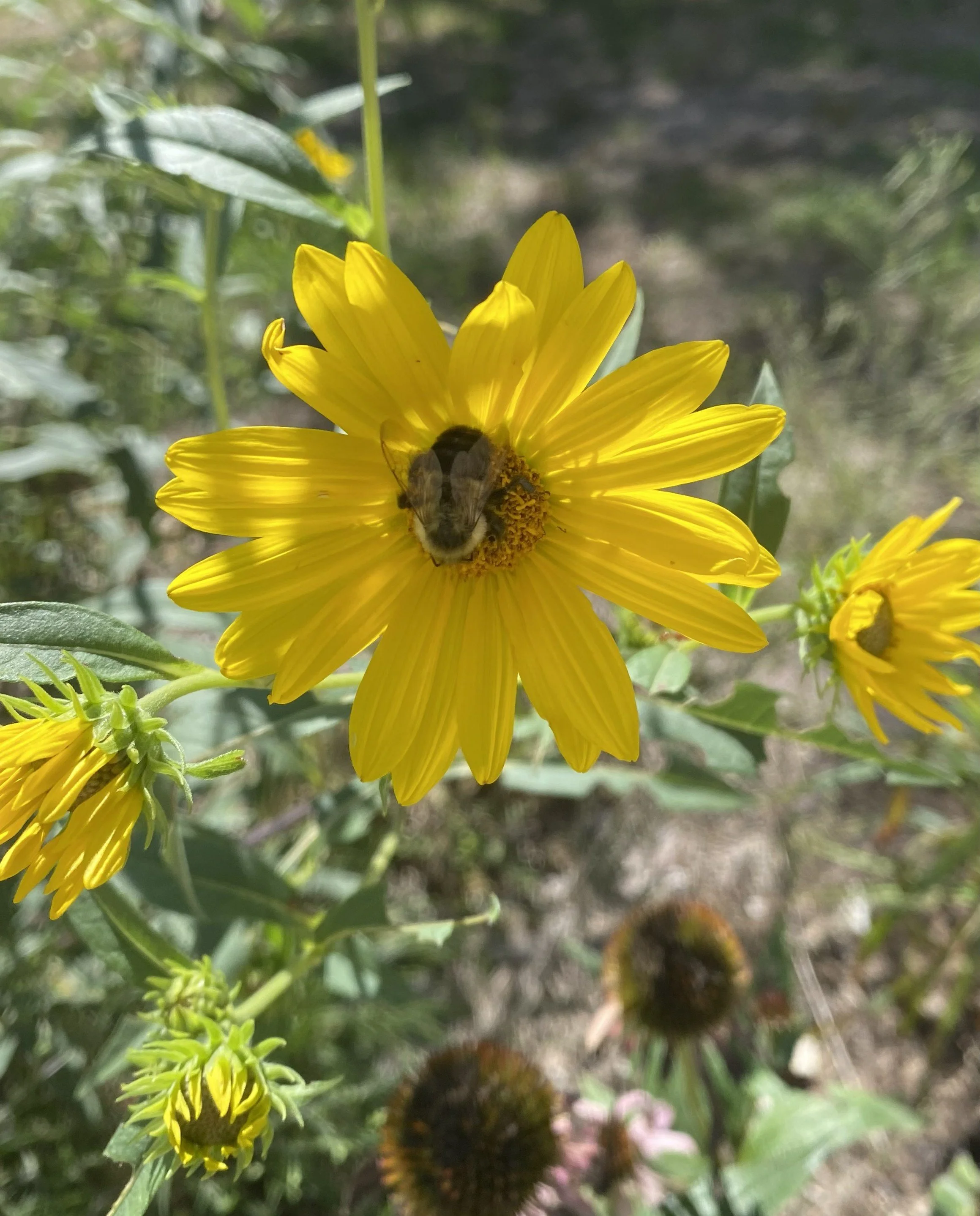
This native is named for the soft, silvery-gray "down" or fuzz that covers its stems and foliage, giving the entire plant a frosty-blue tint. When the mid-summer heat arrives, it erupts in a cheerful display of multi-flowered stalks topped with bright, 2-inch golden-yellow blooms.
What sets the Downy Sunflower apart is its incredible versatility. It is one of the few sunflowers that stays at a manageable height. It is a rugged survivor that handles the hottest, driest corners of your yard with ease, maintaining its silver-green luster even in the peak of a summer drought.
Sun Exposure Full Sun to Partial Sun
Water Needs Low to Medium; very drought-tolerant
Soil Type Poor, drier, Clay, Sand, Rocky, or Well-Drained Loam
Mature Height 4 - 5 feet
Deer Resistance Moderate - High
Bloom Time August – September
Bloom Color Yellow
Plant Spacing 2 – 3 feet
Aggressive Spreader: please consider when picking your planting location. Removal of the seed head before it is ripe is preferable if you do not want to weed seedlings.
Compact Habit: Unlike the towering 8-foot giants, Downy Sunflower stays relatively short and sturdy, rarely requiring staking or support.
Prolific Bloomer: Rather than one single flower head, each plant produces numerous branches, resulting in a dense "bouquet" of yellow flowers on every stalk.
Nectar: Its late-summer blooms are a vital resource for long-tongued bees, butterflies, and skippers during the hottest months of the year.
Bird Seed Source: In the fall, the flower heads dry into nutritious "bird feeders." Chickadees and Goldfinches will cling to the stems to feast on the oil-rich seeds.
Host Plant: It serves as a nursery for the Silvery Checkerspot butterfly and several species of moths.
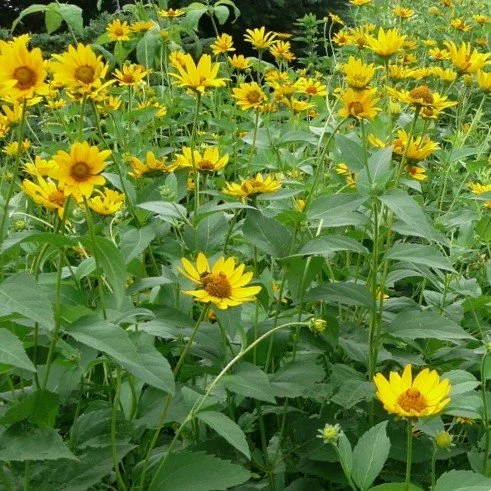
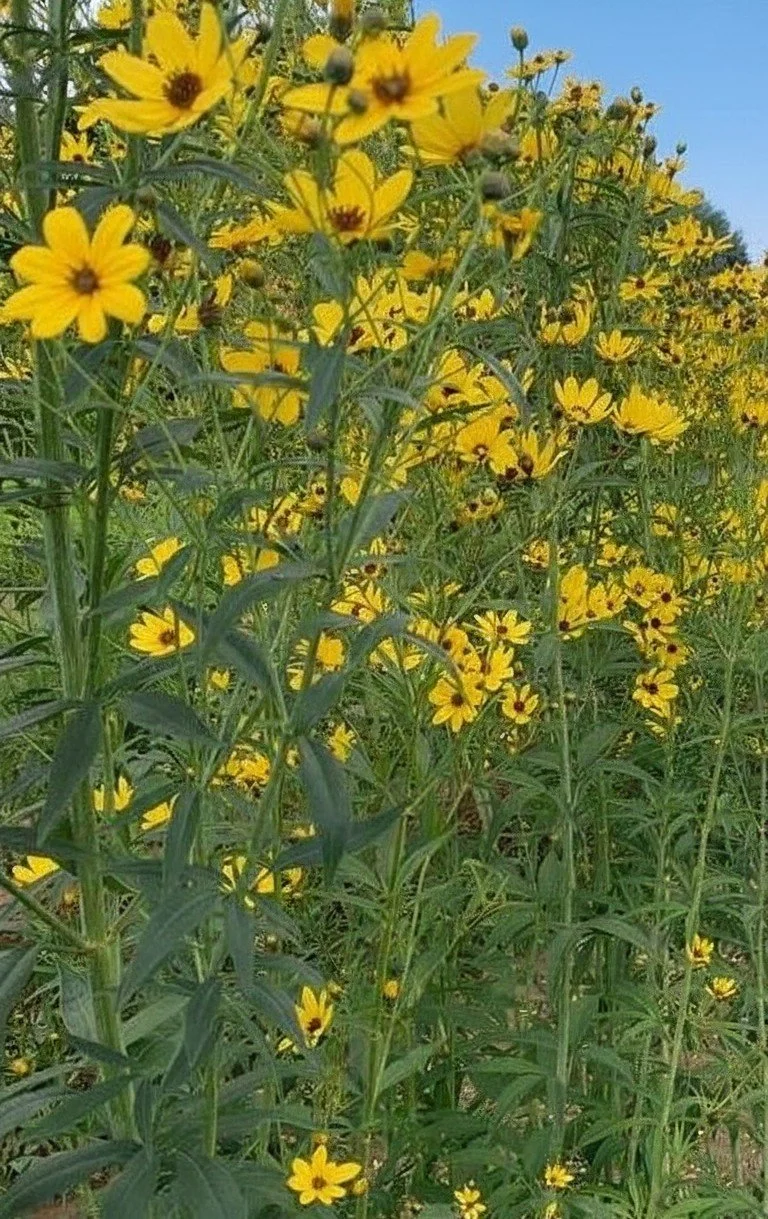
Early Sunflower (often called False Sunflower or Oxeye Sunflower) is a champion of the "pre-autumn" season. While it looks remarkably like a true sunflower, it’s actually a distinct native perennial that is far more manageable and long-lived in a garden setting.
A cheerful, multi-stemmed native that produces a profusion of daisy-like yellow flowers. It is one of the longest-blooming perennials in the summer garden, often starting its show weeks before the rest of the sunflower family.
Sun Exposure Full Sun to Partial Shade (Best in Full Sun)
Water Needs Low to Medium; drought-tolerant once established
Soil Type Adaptable; thrives in Clay, Loam, Sand, or Rocky soil
Mature Height 3 – 5 feet
Deer Resistance Moderate
Bloom Time June – September
Bloom Color Yellow
Plant Spacing 1.5 – 3 feet
Prolific Bloomer: Unlike true sunflowers that bloom once, this species is "deadhead friendly"—removing spent flowers will keep the gold coming all summer long.
Sturdy & Reliable: While it can get tall, its stems are generally stiffer than true sunflowers.However, in very rich soil, it can become "leggy," so it's actually happier in leaner, average soil.
Clump-Forming: It stays where you put it! Unlike some aggressive spreaders, this species grows in a tidy, non-invasive clump that increases in diameter over time.
Specialist Pollinator Support: It is a critical host for the Holcopasites heliopis bee—a tiny specialist pollinator that relies specifically on this plant.
Bird Buffet: If you leave the seed heads standing in the fall, they become a favorite snack for goldfinches and other small songbirds.
Pro Tip: Try planting Early sunflower with purple-blooming companions like Blazing Star or Ironweed that would contrast beautifully with all that yellow.
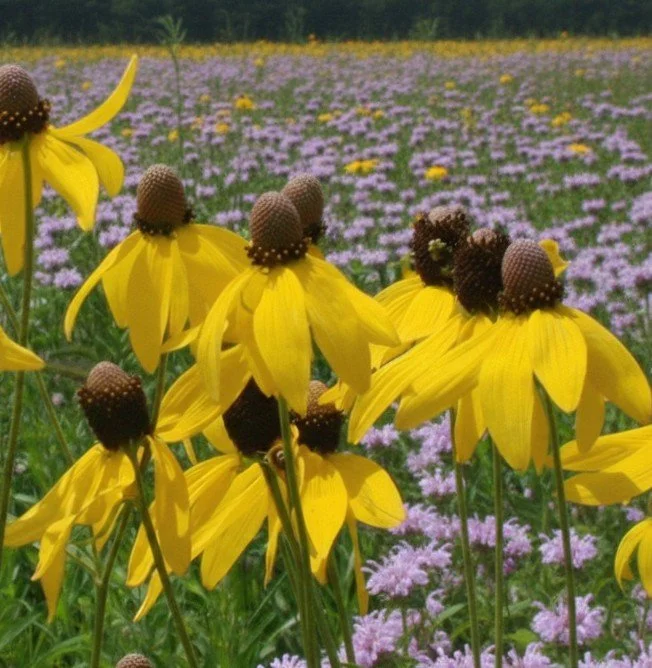
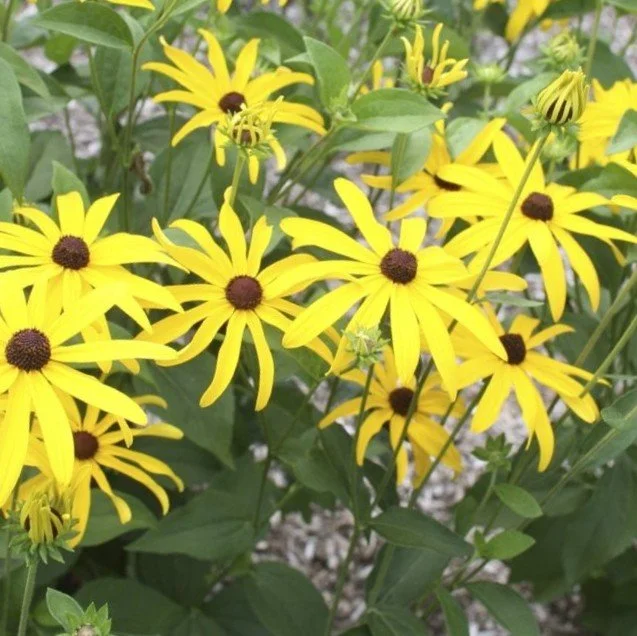
Gray-Headed Coneflower (also known as Yellow Coneflower) is famous for its distinctively drooping petals and a central gray cone that smells like anise or licorice when crushed. This prairie native is known for its tall, slender stems, rough leaves and yellow cheerful flowers. It adds a wonderful sense of motion to the garden, as the blooms sway in the slightest summer breeze. It is native to prairies and savannas and grows best in medium to medium-dry soil conditions.
Sun Exposure Full Sun to Partial Shade
Water Needs Low to Medium; very drought-tolerant once established
Soil Type Adaptable; thrives in Clay, Loam, Sand or Rocky soil
Mature Height 3 – 5 feet
Deer Resistance Moderate - High
Bloom Time July – September
Bloom Color Yellow
Plant Spacing 18 – 24 inches
Distinctive Silhouette: Features bright yellow petals that droop downward, highlighting a prominent gray central cone that turns chocolate brown as the seeds ripen.
Tough as Nails: It is incredibly resilient against heat and drought. It is a reliable "permanent resident" for the back or middle of your garden layers.
Fragrant Cones: When the seed heads are bruised or crushed, they release a pleasant scent described by some as licorice.
Pollinators: The flowers are a high-value nectar source for a diverse range of butterflies, bees and insects.
Winter Bird Feeder: Do not cut the stalks back in the fall! Goldfinches are especially fond of the seeds and will cling to the sturdy cones all winter long to feast.
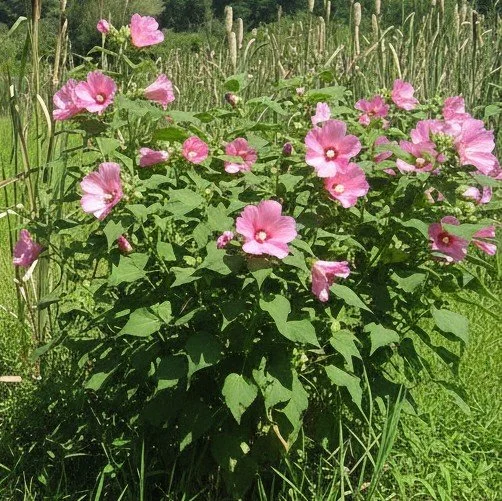
This spectacular native perennial provides a bold, tropical aesthetic with its massive, platter-like blooms. Blossoms reach 6”-10” across with beautiful dark pink centers. While it looks like it belongs in Hawaii, it is a hardy native that adds incredible beauty and height to the mid-to-late summer landscape.
Sun Exposure Full Sun to Partial Shade (Full Sun for best blooms)
Water Needs Medium to High; loves wet "feet" but is surprisingly adaptable
Soil Type Muck, Clay, Loam
Mature Height 4 – 6 feet
Deer Resistance Moderate
Bloom Time July – September
Bloom Color Pink or White
Plant Spacing 2 – 3 feet
Dinner-Plate Blooms: The flowers can range from 6 to 10 inches across. They are typically white or soft pink, usually with a striking dark pink center.
Late Emergence: Don’t be alarmed if you don't see it in early spring! It is one of the last perennials to wake up, often not poking through the soil until June. Once it starts, however, it grows with incredible speed.
Shrub-like Stature: Though it dies back to the ground every winter, it regrows into a massive, multi-stemmed "shrub" by mid-summer. It provides a perfect structural anchor for the back of a large garden bed.
Good for a wetland edge or rain garden
Hummingbirds: The deep, nectar-rich centers and bright colors are a primary target for Ruby-throated Hummingbirds.
Specialist Bee Support: It is the host plant for the Hibiscus Bee (Ptilothrix bombiformis), a specialist pollinator that relies almost exclusively on this genus for pollen.
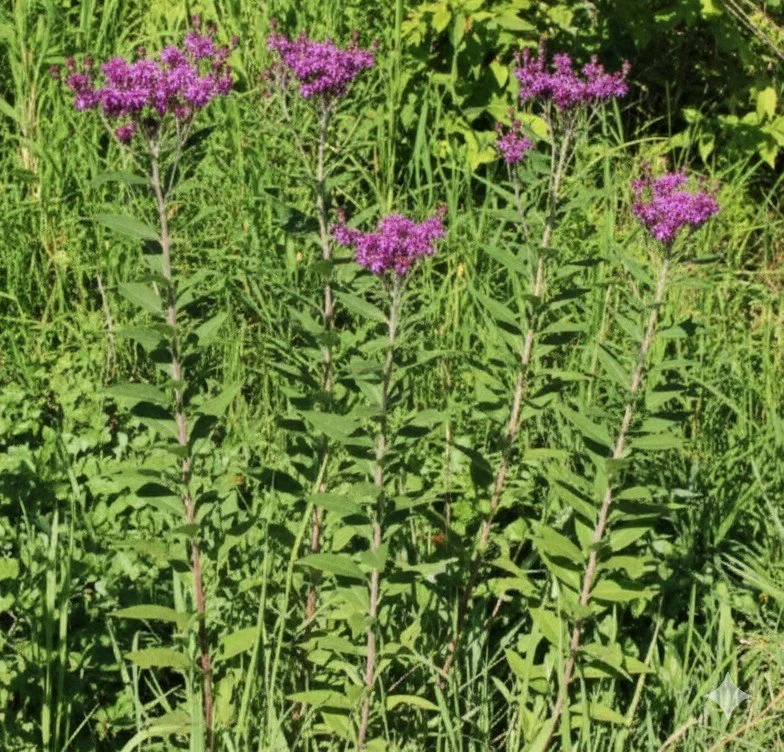
A stately and resilient native, Missouri Ironweed is prized for its intense purple flower clusters and its ability to stand tall without staking. Perhaps the showiest of Ironweeds, it acts as a majestic "anchor" in the garden, signaling the peak of the late-summer season. It provides the garden with a bright magenta color and beautiful, soft texture thanks to its distinctive fuzzy stems and leaves.
Sun Exposure Full Sun
Water Needs Medium; more drought-tolerant than other Ironweeds
Soil Type Adaptable; Clay, Loam, or Sandy/Rocky soil
Mature Height 5 – 6 feet
Deer Resistance High
Bloom Time July – October
Bloom Color Purple
Plant Spacing 2 – 3 feet
Foliage: Unlike its smoother cousins, V. missurica has fine white hairs on the undersides of the leaves and stems, giving the foliage a soft, slightly silvery-green appearance.
Deer Resistant: Ironweeds are bitter to the taste, so they are rarely browsed by deer.
Sturdy: True to its name, the stems are "iron-strong." It provides a rigid vertical line that won't flop over, even when topped with heavy clusters of blooms.
Blooms: Expect to wait 3 years for Ironweed to flower.
Pollinators: In late summer, you will often see this plant covered in Monarchs, Swallowtails, and Skippers. It is a vital fuel stop for migration. It is a high-value source of pollen and nectar for a variety of native bees.
Winter Interest: The spent flower heads turn a silver-tan to rusty-bronze color (hence "Iron" weed) and hold their seeds through the winter, feeding small songbirds like goldfinches.
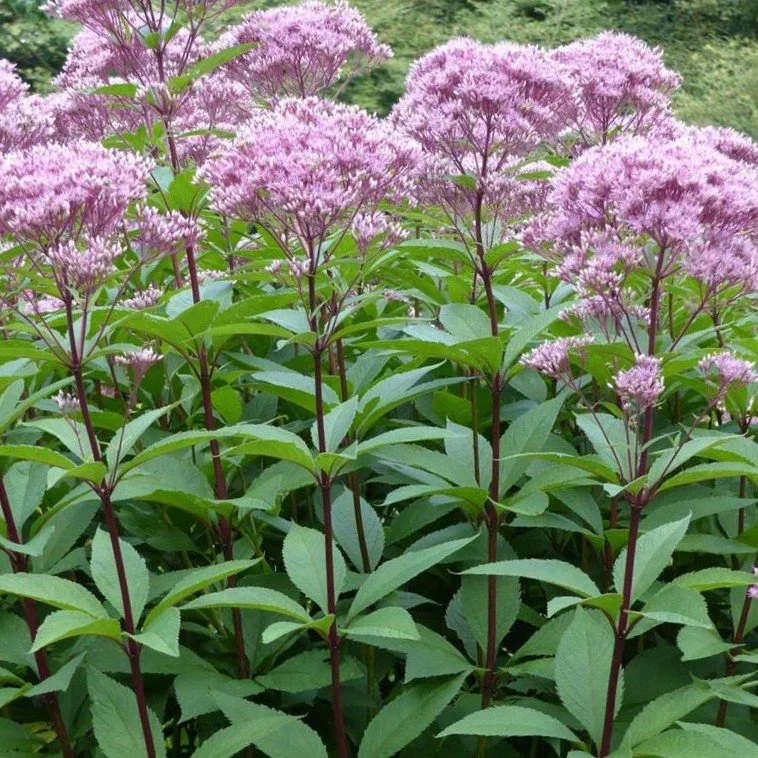
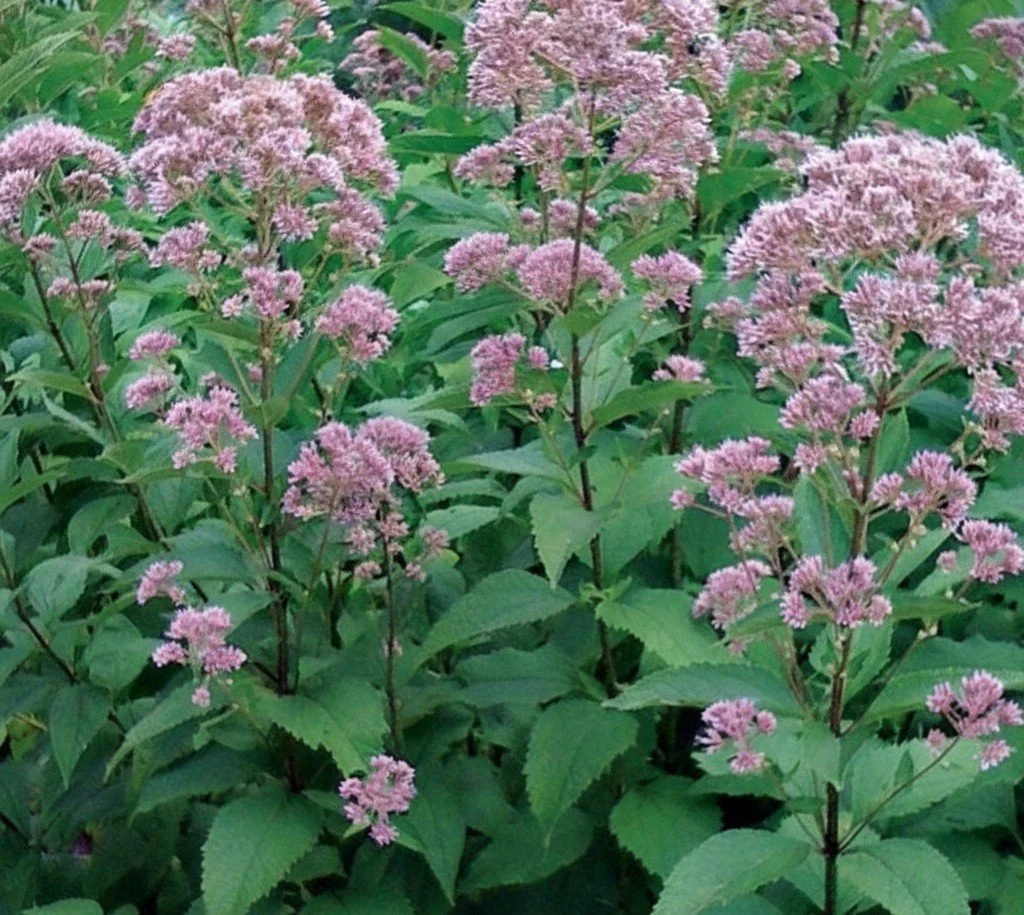
Also known as Spotted Joe Pye Weed, Eutrochium maculatum is loved by dozens of species of butterflies. It grows up to 6’ and it is famous for its massive flower heads that look like soft, dusty-pink clouds floating at the top of the garden. It provides a massive amount of nectar just as the summer heat reaches its peak, acting as a social hub for every butterfly in the neighborhood.
Sun Exposure Full Sun to Partial Shade
Water Needs Medium to High; prefers consistent moisture
Soil Type Adaptable; thrives in rich Muck, Clay, or Loam
Mature Height 5 – 6 feet
Deer Resistance High
Bloom Time July – September
Bloom Color Pink
Plant Spacing 3 – 4 feet
Stems: Its name comes from the distinct purple spots or mottling found along its thick, sturdy stems. These stems are strong enough to hold up the massive flower heads without any staking and are almost the same color as the dusty rose-colored flowers.
Somewhat aggressive spreader. Please keep this in mind when picking your planting site. Use with caution in small landscape situations.
Moisture lover: Unlike other Joe Pye Weeds, this one requires the most moisture. It is perfect for planting in damp settings such as along pond edges, streambanks and drainage areas.
Butterflies: Because the flower heads are flat and wide, they provide a perfect "landing pad" for dozens of butterfly species.
Native Bee Favorite: It is an incredibly high-value nectar source for bumblebees and many species of native bees.
Birds: Several species of birds benefit from eating the seeds and many birds feed of insects that are drawn to the plant.
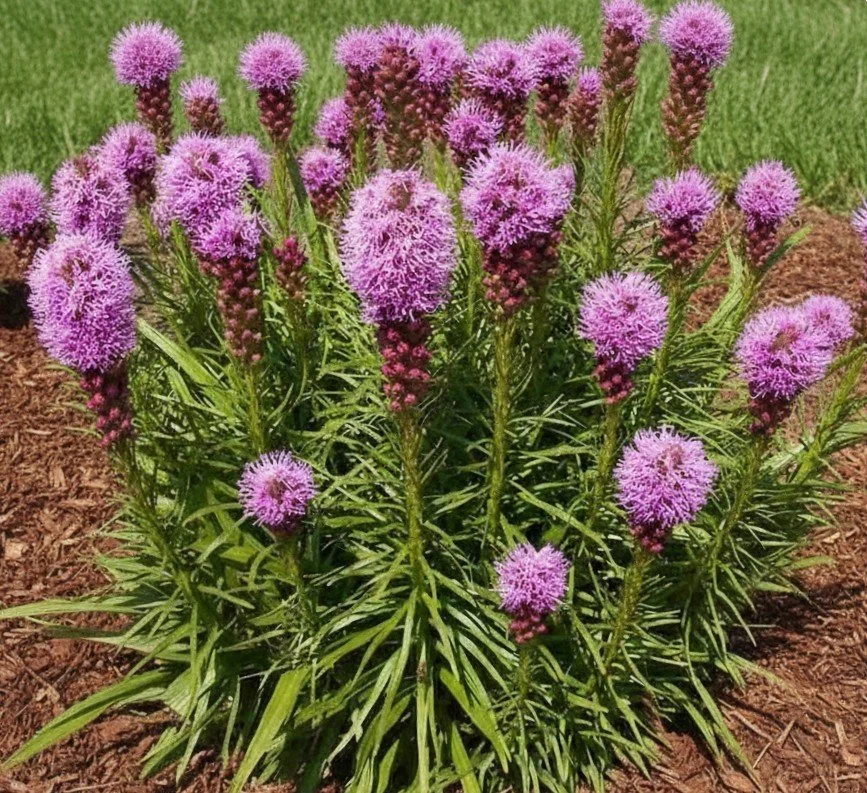
Also known as Dense Blazing Star, this plant features stiff, upright stems covered in grass-like foliage, topped with thick spikes of feathery, magenta-purple flowers that look like glowing sparklers in the summer sun. Marsh Blazing Star is native to moist meadows and marsh margins of the Midwest. It is a standard component of naturalized moist prairies, butterfly gardens, water feature margins, and rain gardens.
Sun Exposure Full Sun (preferred) to Partial Shade
Water Needs Medium to High; prefers moist soil but is quite adaptable
Soil Type Adaptable; thrives in Muck, Clay, Loam, or Moist Sand
Mature Height 3 – 5 feet
Deer Resistance Moderate - High
Bloom Time July – September
Bloom Color Lavendar - Purple
Plant Spacing 1 – 2 feet
Blooms: Unlike most spiked flowers that bloom from the bottom up, Liatris starts at the very tip of the wand and works its way down, extending its beauty over several weeks.
Corm-Based Growth: It grows from a bulb-like structure called a corm. This makes it a very "polite" neighbor; it won't spread aggressively or take over your garden beds.
Distinctive Texture: Before the flowers appear, the plant looks like a lush clump of fine, fountain-like grass, providing excellent green texture in the early spring.
Monarch Fuel: This is arguably one of the best plants for Monarch and other butterflies. During their migration, you will often see several butterflies jostling for position on a single flower spike.
Bumblebee Favorite: The feathery "stars" are packed with nectar, making them a high-priority stop for bumblebees and clearwing hummingbird moths.
Bird Feeder: If you leave the stalks up in the fall, goldfinches and other songbirds will visit the garden to feast on the small, nutritious seeds.
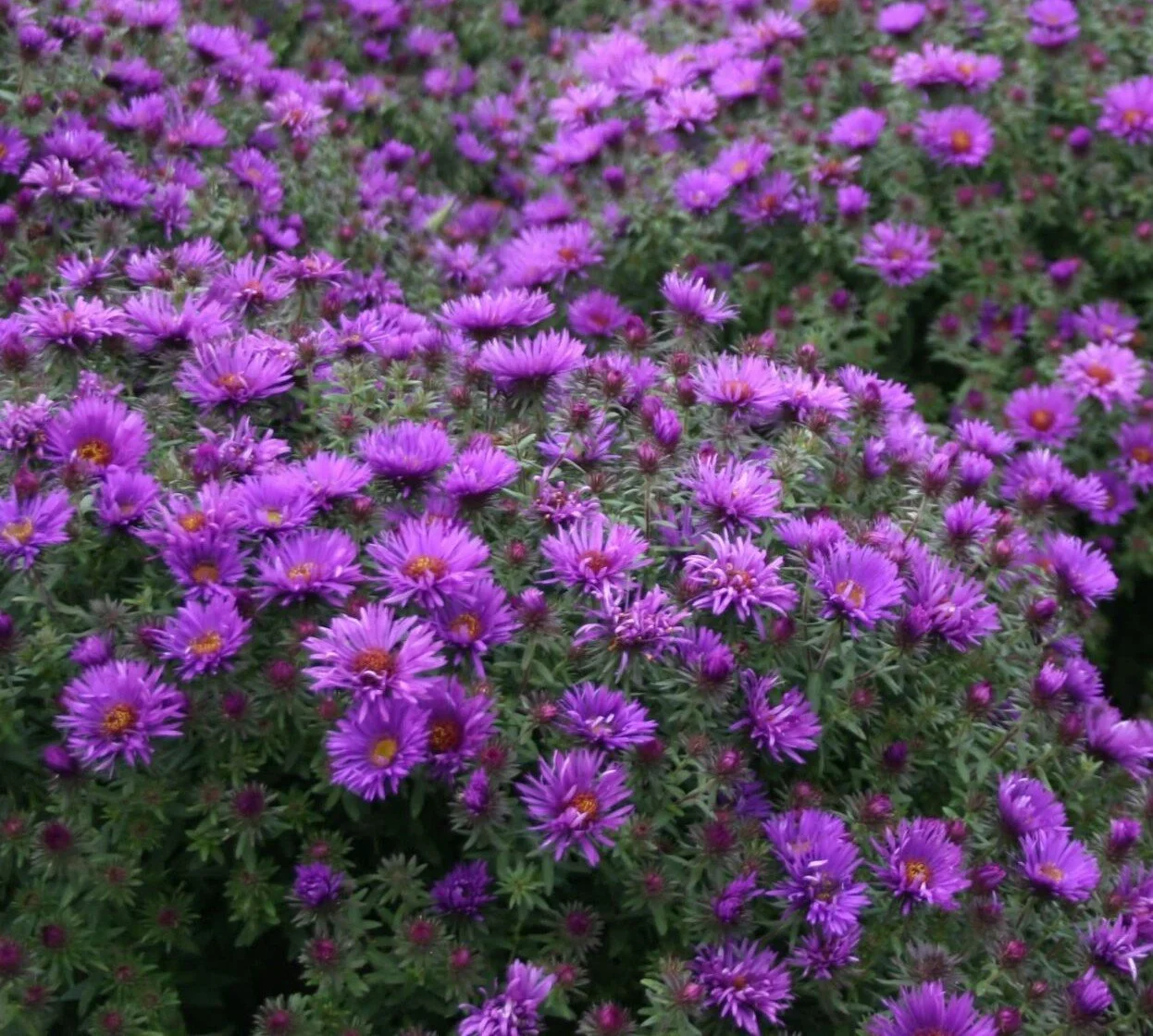
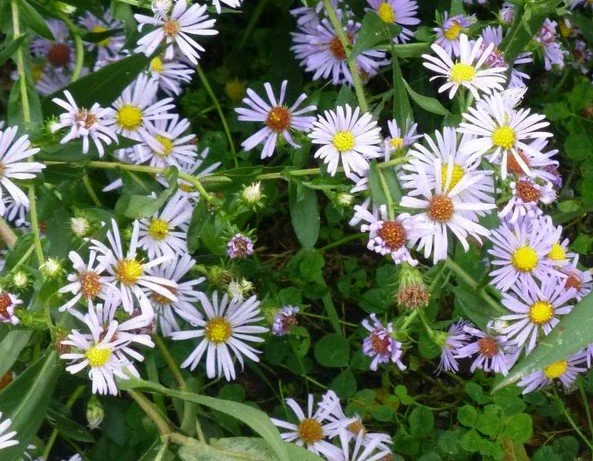
While other plants are winding down for winter, this aster explodes into a cloud of vivid purple and gold, providing one last massive feast for pollinators. A robust and showy native perennial that is famous for its late-season bloom. Its stems are topped with hundreds of daisy-like, deep violet-to-pink flowers with bright yellow centers, creating stunning color in the autumn landscape.
Sun Exposure Full Sun (best for bloom density) to Partial Shade
Water Needs Medium; prefers consistent moisture but is adaptable
Soil Type Adaptable; Muck, Clay, Loam, or Sand
Mature Height 3 – 5 feet
Deer Resistance Moderate
Bloom Time August – October
Bloom Color Purple
Plant Spacing 2 – 3 feet
Color: Blooms can range in color from purple, violet and shades of pink.
The "Hairy" Stem: Similar to the Hoary Vervain, the stems of New England Aster are covered in fine, bristly hairs, which helps with easy identification.
Foliage: It is natural for the bottom leaves of this plant to turn brown and drop off by late summer. This is just the plant focusing its energy on the flowers at the top! You can easily hide this by planting shorter natives in front of it.
Aggressive self-seeder: Please keep in mind when selecting your planting sites. Removal of the seed heads before the seed is ripe will help prevent it from spreading or the need to weed unwanted seedlings.
Migration Fuel: Provides critical, high-energy nectar for Monarchs and other butterflies into late fall.
Bees: It is a vital resource for late-emerging specialist bees and bumblebee queens who are preparing to overwinter.
Host Plant: It serves as a larval host for the Pearl Crescent butterfly and several species of moths.
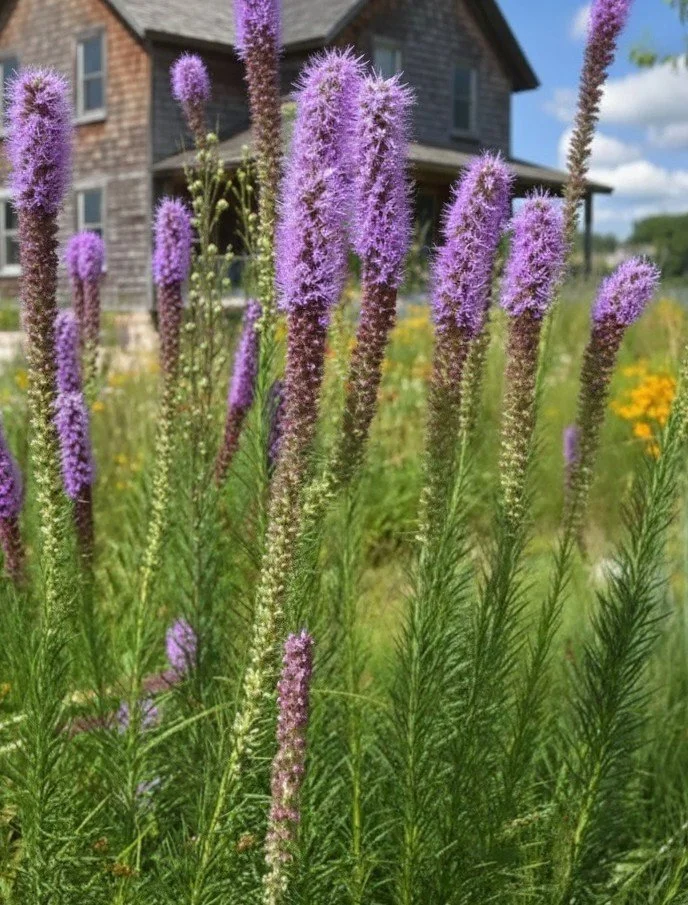
Prairie Blazing Star is famous for its exceptionally crowded flower spikes. The species name pycnostachya literally means "thick-spiked," which perfectly describes the way the fuzzy purple flowers are packed tightly together on the stem. It is an excellent species to plant in wet-medium perennial gardens or prairies.
Sun Exposure Full Sun to Partial Shade
Water Needs Medium; prefers consistent moisture but tolerates dry spells
Soil Type Clay, Loam, or Moist Sand
Mature Height 4 feet
Deer Resistance Moderate
Bloom Time July – September
Bloom Color Purple
Plant Spacing 12 – 18 inches
Blooms: Because the flowers are so densely packed, the entire top 1–2 feet of the plant becomes a solid column of vibrant purple. It creates a much bolder "block" of color than other Liatris species.
Top-Down Bloom: Like its cousins, it starts blooming at the very top of the spike and slowly works its way down, ensuring several weeks of continuous color.
Stalks: The stems are very rigid and covered in narrow, grass-like leaves, giving the plant a very clean, architectural look before it even begins to flower.
Butterflies: Along with the Marsh Blazing Star, this is a stop for Monarchs and other butterflies.
Bees and Hummingbirds: It is a favorite of bumblebees and other large native bees and hummingbirds in the height of summer.
Host Plant: Prairie Blazing Star is a host plant for numerous small moths.
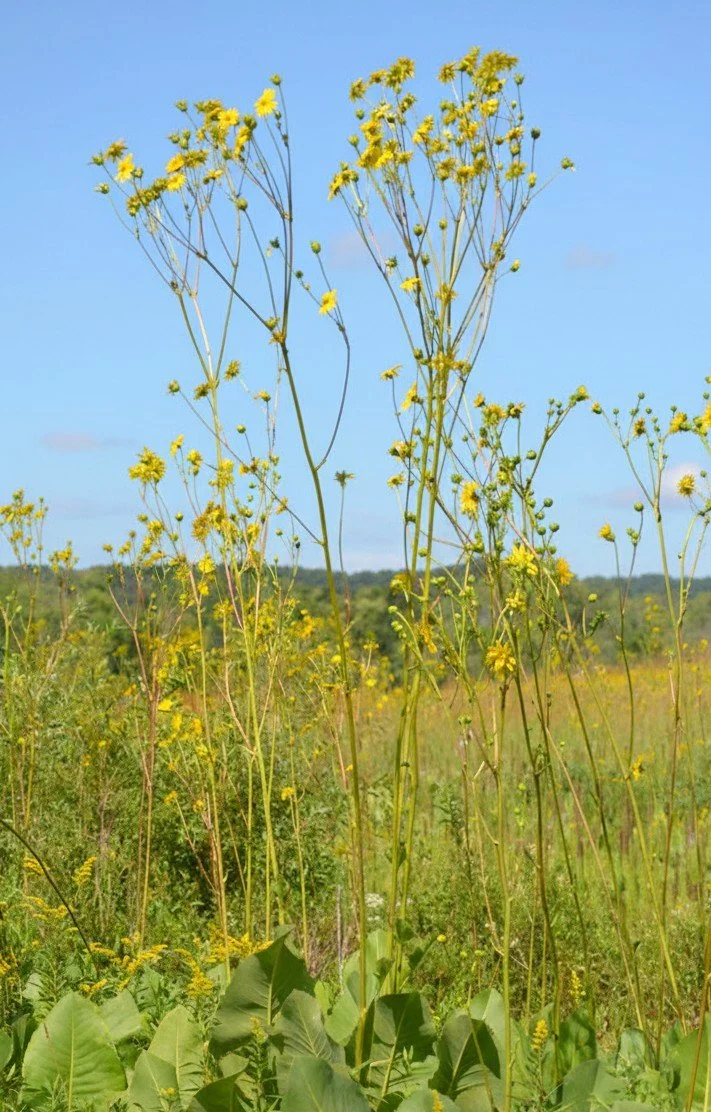
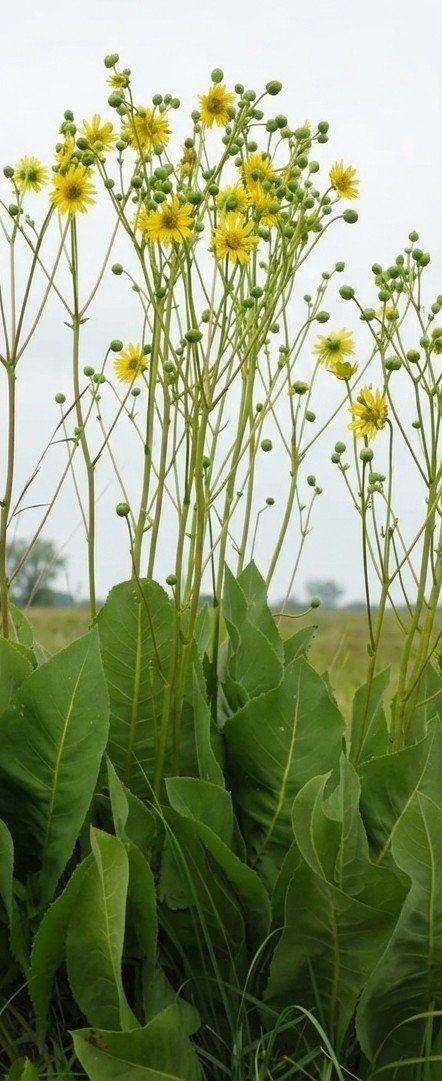
A long-lived, slow-growing giant known for having some of the largest leaves of any native plant. The foliage stays low to the ground in a dramatic clump, while the smooth, leafless flower stalks skyrocket upward, topped with bright, sunflower-like blooms.
Sun Exposure Full Sun to Partial Shade
Water Needs Medium; exceptionally drought-tolerant once established
Soil Type Clay, Loam, Sand or Rocky soil
Mature Height up to 9 feet
Deer Resistance High
Bloom Time July – September
Bloom Color Yellow
Plant Spacing 2 – 4 feet
Massive Leaves: The leaves can grow up to 18” long and 12” wide. They are stiff, leathery, and have a texture like sandpaper. Because they are held vertically to minimize sun exposure, they are incredibly efficient at surviving hot, dry summers.
Stems: Unlike its cousin, the Compass Plant, Prairie Dock has completely smooth, leafless flower stalks.
Roots: It grows a massive taproot that can reach 10–15 feet into the earth. This makes it very drought resistant, but it also means you must pick its forever home carefully, as it cannot be moved once established.
Pollinators: The yellow flowers attract large butterflies, honeybees and bumblebees.
Birds: Because the stalks are so strong and tall, they serve as excellent hunting perches and birds love the seed.
Pro Tip: Plant it at the very back of your border. The massive leaves provide a solid green "wall" at ground level, while the yellow flowers dance high above your New England Aster and Ironweed.
No results match your search. Try removing a few filters.