
 Image 1 of 1
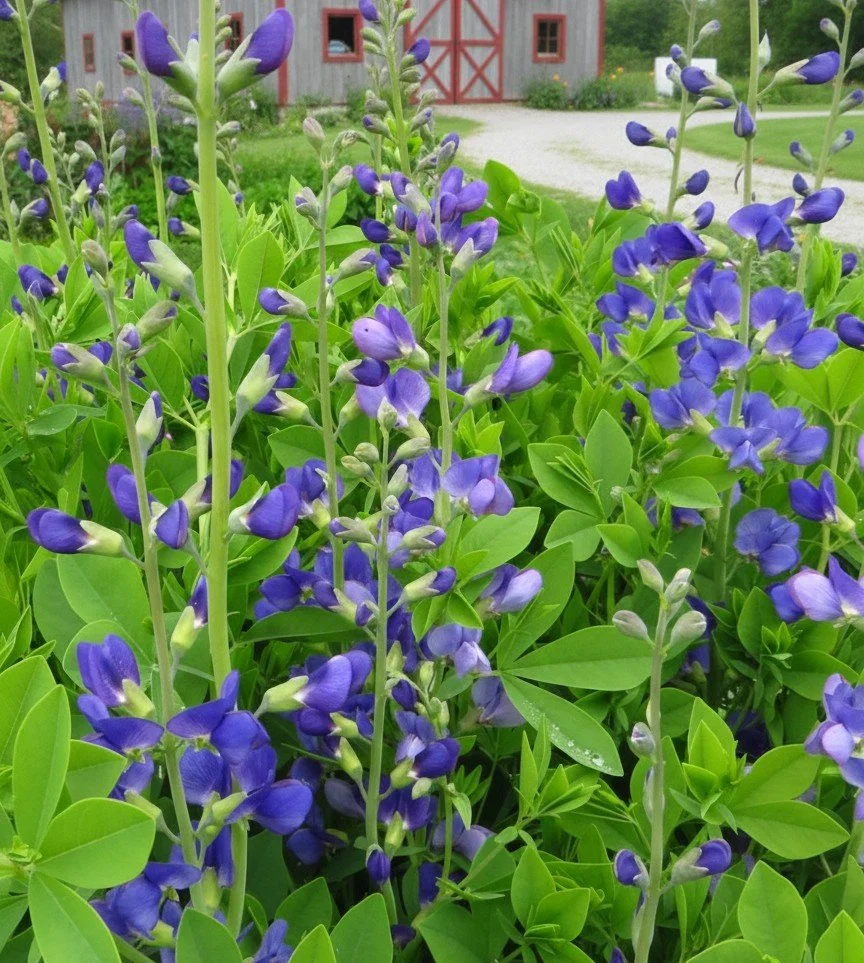
An elegant, long-lived native that looks more like a small shrub than a typical flower. In late spring, it produces tall spikes of deep indigo-blue flowers that resemble Lupine, providing a cool contrast to the yellow-heavy palette of the summer garden. It is often called the "Perennial of the Year" for good reason—it is practically indestructible and offers a shrub-like presence without the woody maintenance.
Sun Exposure Full Sun to Partial Shade (Best in Full Sun)
Water Needs Low to Medium; exceptionally drought-tolerant once established
Soil Type Adaptable; thrives in Clay, Loam, Sand, or Rocky soil
Mature Height 3 – 4 feet
Deer Resistance High
Bloom Time May – July
Bloom Color Blue
Plant Spacing 2 – 3 feet
Deep-Rooted Longevity: It features one of the deepest taproots of any native plant, making it nearly impossible to kill once established—but also very difficult to move! Pick its "forever home" carefully.
It will spend most of the first couple years developing mostly below ground
Shrub-like Structure: While it dies back to the ground in winter, it regrows into a dense, mounded shape with beautiful blue-green, clover-like foliage that stays attractive all summer long.
Because of it’s wide form, generous spacing is recommended.
Bees: The "pea-shaped" flowers are specifically designed for heavy-bodied bees, like Bumblebees, who are strong enough to push the petals open to reach the nectar.
Butterfly Host: It serves as a vital nursery for several butterfly species, including the Wild Indigo Duskywing and the Frosted Elfin.
An elegant, long-lived native that looks more like a small shrub than a typical flower. In late spring, it produces tall spikes of deep indigo-blue flowers that resemble Lupine, providing a cool contrast to the yellow-heavy palette of the summer garden. It is often called the "Perennial of the Year" for good reason—it is practically indestructible and offers a shrub-like presence without the woody maintenance.
Sun Exposure Full Sun to Partial Shade (Best in Full Sun)
Water Needs Low to Medium; exceptionally drought-tolerant once established
Soil Type Adaptable; thrives in Clay, Loam, Sand, or Rocky soil
Mature Height 3 – 4 feet
Deer Resistance High
Bloom Time May – July
Bloom Color Blue
Plant Spacing 2 – 3 feet
Deep-Rooted Longevity: It features one of the deepest taproots of any native plant, making it nearly impossible to kill once established—but also very difficult to move! Pick its "forever home" carefully.
It will spend most of the first couple years developing mostly below ground
Shrub-like Structure: While it dies back to the ground in winter, it regrows into a dense, mounded shape with beautiful blue-green, clover-like foliage that stays attractive all summer long.
Because of it’s wide form, generous spacing is recommended.
Bees: The "pea-shaped" flowers are specifically designed for heavy-bodied bees, like Bumblebees, who are strong enough to push the petals open to reach the nectar.
Butterfly Host: It serves as a vital nursery for several butterfly species, including the Wild Indigo Duskywing and the Frosted Elfin.