
 Image 1 of 1
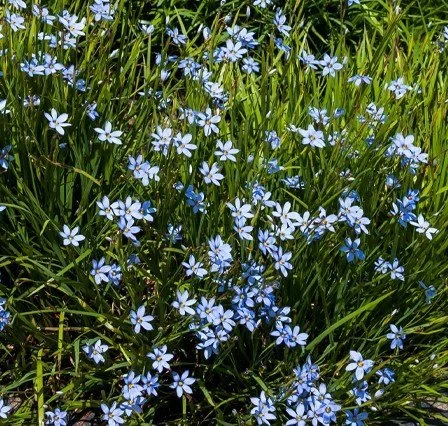
Don't let the name fool you—Blue-Eyed Grass is not a grass at all, but a dainty and delightful member of the Iris family. This charming native perennial forms tidy, tufted clumps of narrow, sword-shaped green foliage that looks like a miniature ornamental grass. In late spring, the "grass" is topped by a profusion of star-shaped, violet-blue flowers, each featuring a bright, sunny-yellow "eye" at the center.
Perfect for those who appreciate the finer details of a garden, Blue-Eyed Grass is ideal for lining walkways, tucking into rock gardens, or adding a delicate texture to the front of a perennial border. It’s a small plant that makes a big impact when it blankets the ground in blue.
Sun Exposure: full sun to partial shade
Water Needs: moderate; prefers consistent moisture but can handle brief dry spells.
Soil Type: well-drained; will tolerate loam or sand.
Mature Height: 6 inches
Deer Resistance: Low-Moderate
Bloom Time: May – June
Plant Spacing: 6 – 8 inches
Compact Habit: Its small footprint makes it perfect for "tight" spaces or small urban gardens where every inch counts.
Tidy All Season: Even when not in bloom, the upright, iris-like foliage remains attractive and structured throughout the growing season.
Easy to Naturalize: It will gently self-seed and spread via underground rhizomes, slowly forming a beautiful, flowering groundcover.
Early Season Pollinators: Provides an important nectar source for small native bees and hoverflies during the crucial late-spring window.
Habitat Value: The dense, tufted foliage offers excellent cover for beneficial insects and small amphibians near the soil surface.
Seed Source: Small songbirds occasionally feast on the tiny seeds that develop after the flowers fade.
Pro Tip: Blue-Eyed Grass looks its best when planted in large drifts or groups. Because of its small stature, a single plant might get lost. Try planting in a groups of 5 or 7.
Don't let the name fool you—Blue-Eyed Grass is not a grass at all, but a dainty and delightful member of the Iris family. This charming native perennial forms tidy, tufted clumps of narrow, sword-shaped green foliage that looks like a miniature ornamental grass. In late spring, the "grass" is topped by a profusion of star-shaped, violet-blue flowers, each featuring a bright, sunny-yellow "eye" at the center.
Perfect for those who appreciate the finer details of a garden, Blue-Eyed Grass is ideal for lining walkways, tucking into rock gardens, or adding a delicate texture to the front of a perennial border. It’s a small plant that makes a big impact when it blankets the ground in blue.
Sun Exposure: full sun to partial shade
Water Needs: moderate; prefers consistent moisture but can handle brief dry spells.
Soil Type: well-drained; will tolerate loam or sand.
Mature Height: 6 inches
Deer Resistance: Low-Moderate
Bloom Time: May – June
Plant Spacing: 6 – 8 inches
Compact Habit: Its small footprint makes it perfect for "tight" spaces or small urban gardens where every inch counts.
Tidy All Season: Even when not in bloom, the upright, iris-like foliage remains attractive and structured throughout the growing season.
Easy to Naturalize: It will gently self-seed and spread via underground rhizomes, slowly forming a beautiful, flowering groundcover.
Early Season Pollinators: Provides an important nectar source for small native bees and hoverflies during the crucial late-spring window.
Habitat Value: The dense, tufted foliage offers excellent cover for beneficial insects and small amphibians near the soil surface.
Seed Source: Small songbirds occasionally feast on the tiny seeds that develop after the flowers fade.
Pro Tip: Blue-Eyed Grass looks its best when planted in large drifts or groups. Because of its small stature, a single plant might get lost. Try planting in a groups of 5 or 7.